Loading…
 Tuesday, September 29Tuesday, September 29
4 months · 20 summary articles
G7 leaders meeting in Évian-les-Bains on Tuesday intensified pressure on Russia to end its war in Ukraine, with US President Donald Trump urging Moscow to “make a deal” after a trilateral session with Ukrainian President Volodymyr Zelensky. Speaking at the lakeside summit, Trump said Russia should negotiate a settlement, marking a shift in tone after months in which Washington’s focus had drifted toward the US-Israeli conflict with Iran. European allies seized on the moment to press Trump for concrete support, while Zelensky joined working sessions aimed at tightening sanctions and boosting Ukraine’s air defences.
The call for negotiations came as G7 foreign ministers finalised a package of measures designed to increase the cost of Russia’s invasion, now in its fifth year. European Commission President Ursula von der Leyen told reporters that leaders would unveil fresh sanctions targeting Russian energy and military logistics within 48 hours. French President Emmanuel Macron, co-hosting the summit, said the moment was “now or never” for diplomacy to halt the fighting that has already outlasted the First World War.
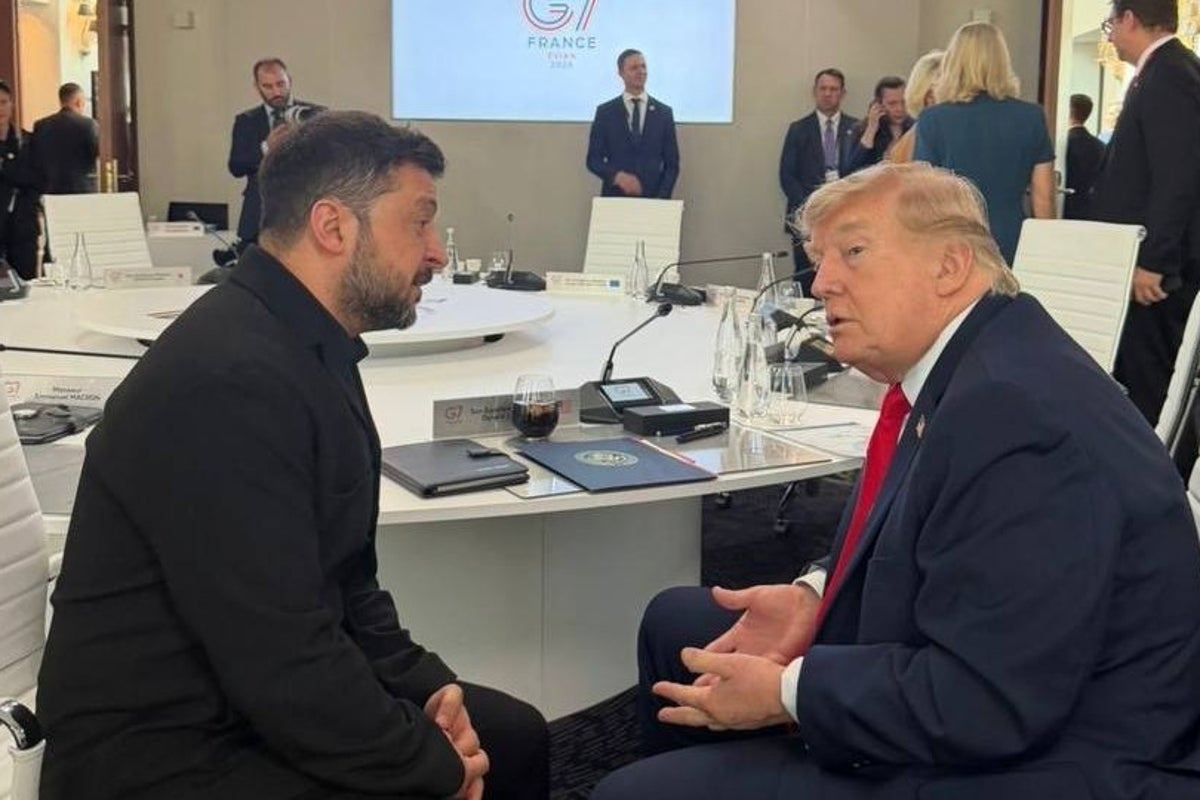
Trump’s remarks followed a 45-minute meeting with Zelensky, the first face-to-face encounter between the two leaders since February. A photograph posted by Zelensky’s office showed the two men seated under French sunlight, with the Ukrainian president later thanking G7 partners for “strong ideas on how to force Russia into peace.” The White House said Trump had pledged to use “all available leverage” to push for a ceasefire, though no specific commitments were announced.
Analysts noted that Trump’s intervention came as European capitals sought to rebalance his priorities. German Chancellor Olaf Scholz told reporters that Ukraine’s survival remained “the defining security test of our time,” while Italian Prime Minister Giorgia Meloni warned that any deal must respect Kyiv’s sovereignty. The Kremlin, responding through its London-based spokesman, dismissed the G7’s calls as “empty posturing,” insisting that Russia would only negotiate from a position of strength.
With Russian strikes continuing to batter Ukrainian cities, the summit’s working groups are expected to approve emergency deliveries of long-range missiles and radar systems by the end of the week. A senior US official, speaking on condition of anonymity, said Washington was reviewing requests for F-16 transfers that could arrive within months. The official added that Trump’s shift reflected both battlefield realities and domestic political pressure ahead of November’s congressional elections.
Follow us for live European news
2 further sources not geolocated

Trump joins G7 talks on Ukraine in France amid reported Macron friction US President Donald Trump on Tuesday participated in a G7 working session with Ukrainian President Volodymyr Zelensky and European leaders in Evian, France, where he received a German national team jersey and faced reported tensions with host Emmanuel Macron during earlier bilateral talks.
yenisafak · 3 months ago
Trump îi cere lui Putin să încheie războiul din Ucraina, după o discuție surpriză cu Zelenski și Macron în marja G7 Președintele Ucrainei, Volodimir Zelenski, s-a întâlnit cu președintele SUA, Donald Trump, și cu președintele Franței, Emmanuel Macron, în marja summitului G7 din Franța, potrivit unor surse familiarizate cu discuțiile, citate de Kyiv Independent.
digi24 · 3 months ago
G7 a Evian, news. Trump dopo il colloquio con Zelensky: La Russia deve fare un accordo Trilaterale del presidente ucraino con Macron e Trump. Lincontro prima della sessione dedicata allUcraina: si tratta del primo confronto faccia a faccia tra il leader ucraino e quello americano in quasi quattro mesi
corriere · 3 months ago
G-7-Gipfel in Évian: Willst du in meiner Mannschaft spielen? In einem Luxushotel am Genfer See bekommt Donald Trump ein spezielles Wellness-Programm. Der Präsident soll nach seinem Iran-Deal wieder ins Team Westen geholt werden. Die Ukraine darf ein wenig Hoffnung schöpfen.
sueddeutsche · 3 months ago
EU, signs of a new political normality: conclusions on Ukraine agreed by all 27 member states at the leaders summit The summit of heads of state and government is expected to reaffirm its commitments to Kyiv, as is traditional: this is the only significant aspect of what is essentially an interim meeting. On the multi-annual budget, China, Iran and relations with Israel, efforts are being made to find a common position, but none has yet been reached
eunews.it · 3 months ago

U.S. Allies Use G-7 to Focus Trumps Attention Back to Ukraine The president has spent the past four months focused on Iran, but the Group of Seven summit has left him little choice but to turn his attention back to Ukraine.
wsj · 3 months ago
Opinion: The future of the China-US-Russia triangle after Pelosis visit to Taiwan Since February 24, 2022, the international communitys focus was concentrated entirely on the war in Ukraine and the growing Russia – West confrontation. It seemed that nothing could change the situation until the end of hostilities in Ukraine. However, on August 2 and 3, almost everyones attention shifted from Ukraine to Taiwan. As the Speaker of the US House of Representatives, Nancy Pelosi, stated her intention to visit Taiwan, up to half a million people were watching the trajectory of her plane on air flight tracking sites. The negative reaction of China, including the warning of President Xi during his conversation with President Biden that those who played with fire would be perished by it, created hype around this visit. Many were discussing the possibility of Chinese military jets closing the airspace over Taiwan and preventing Pelosis plane from landing in Taiwan, while some enthusiasts were even contemplating the possibility of a US-China direct military clash. As Pelosi landed in Taiwan and met with the Taiwanese President, the global social media was full of amateur assessments about the strategic victory of the US and the confirmation of the US global hegemony. However, as the dust settles down, and information noise and manipulation eventually decreases, a more serious assessment is needed to understand the real consequences of this visit.
commonspace · 3 months ago
G7 Leaders Agree to Intensify Pressure on Russia "Russia should make a deal" to end the war against Ukraine, Donald Trump said after meeting with Volodymyr Zelensky on Tuesday.
themoscowtimes · 3 months ago
Ukraine-Russia war latest: Trump tells Putin to make a deal to end war as US president meets with Zelensky at G7 summit The US president vowed to do what he can to end the conflict as Zelensky took part in working sessions at the event
independent · 3 months ago
The Latest: Trump at G7 summit for talks with world leaders on Iran and Ukraine
gdeltproject.org · 3 months ago
G7: Trump says Russia should make a deal on Ukraine
gdeltproject.org · 3 months ago

Zelenskyy thanks G7 leaders for strong ideas on how to force Russia into peace – as it happened Ukrainian president praises successful talks after Trumps comments that Russia should make a deal after G7 meeting… and given the delay this morning, the meeting may or may not have happened already – guess we will find out at some point during the day.in Évian-les-Bains Continue reading...
theguardian · 3 months ago
Can Trump be convinced to back Ukraine? - The Latest Donald Trump has urged Russia to make a deal with Ukraine as the leaders of G7 countries meet on Tuesday and try to put the conflict back at the top of the agenda. European leaders are hoping to capture Trumps attention for long enough to speak to him about Ukraine, with the US presidents focus more on the US-Israeli war against Iran. Nosheen Iqbal speaks to the Guardians Europe correspondent Jon Henley. Continue reading...
theguardian · 3 months ago
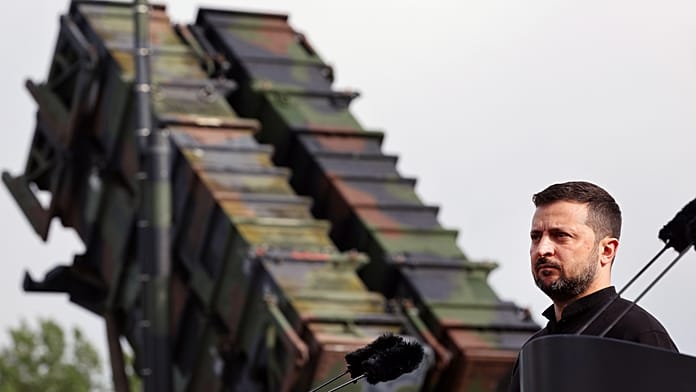
Kyiv seeks license to produce Patriot systems for Ukraine and Europe With Russia deliberately targeting Ukraines energy system each winter, Volodymyr Zelenskyy said at the G7 summit that he wants to bring the war to an end before the next cold season. Kyiv now holds a stronger position both on the battlefield and in its strikes deep in Russia.
euronews · 3 months ago

Trump Says U.S. Has Nothing to Do with Ukraine War at G7 Summit President Trumps remarks underscored a new security reality for U.S. allies in Europe, who for eight decades relied on American protection.
new york times · 3 months ago
G7 united on need to force Putin to end war via sanctions – Zelenskyy Ukrainian President Volodymyr Zelenskyy has said that all G7 countries see no willingness on Russias part to end the war and believe it must be compelled to negotiate through sanctions.
ukrpravda · 3 months ago
EU leaders to discuss next steps towards Ukraines accession with Zelenskyy EU leaders will discuss the next steps towards Ukraines accession to the EU and its potential involvement in peace talks during a discussion with Ukrainian President Volodymyr Zelenskyy at a European Council meeting in Brussels on the evening of 18 June.
ukrpravda · 3 months ago
Politico captures Zelenskyy and Macron discussing how to engage with Trump Ukrainian President Volodymyr Zelenskyy and French President Emmanuel Macron discussed plans for engaging with US President Donald Trump upon Zelenskyys arrival at the G7 summit, according to a conversation inadvertently captured by a cameras microphone.
ukrpravda · 3 months ago
Macron will, dass Trump bei Ukraine endlich aktiv wird [premium] Der US-Präsident feiert sich beim G7-Gipfel in Évian als Friedensbringer im Iran. Die Europäer pochen aber auf Lösung für Ukraine.
die presse · 3 months ago
Now is the moment: G7 powers push Russia to end Ukraine war G7 leaders agreed on Tuesday to intensify pressure on Russia to end more than four years of war against Ukraine, with US President Donald Trump saying Moscow should "make a deal". Ukrainian President Volodymyr Zelensky joined the summit at the French resort of Evian-les-Bains, with Ukraine seen as holding up well on the battlefield but its cities still the target of deadly Russian attacks in a conflict that has now lasted longer than World War I.
france24 · 3 months ago
Zelenskyy posts photo of conversation with Trump: "It is always important to coordinate positions" Ukrainian President Volodymyr Zelenskyy has posted photos of his meeting with US President Donald Trump on the sidelines of the G7 summit in France.
ukrpravda · 3 months ago