
Armenias Pashinyan claims victory as pro-Western party secures majority, defying Russia
Story Timeline
4 months · 12 summary articles
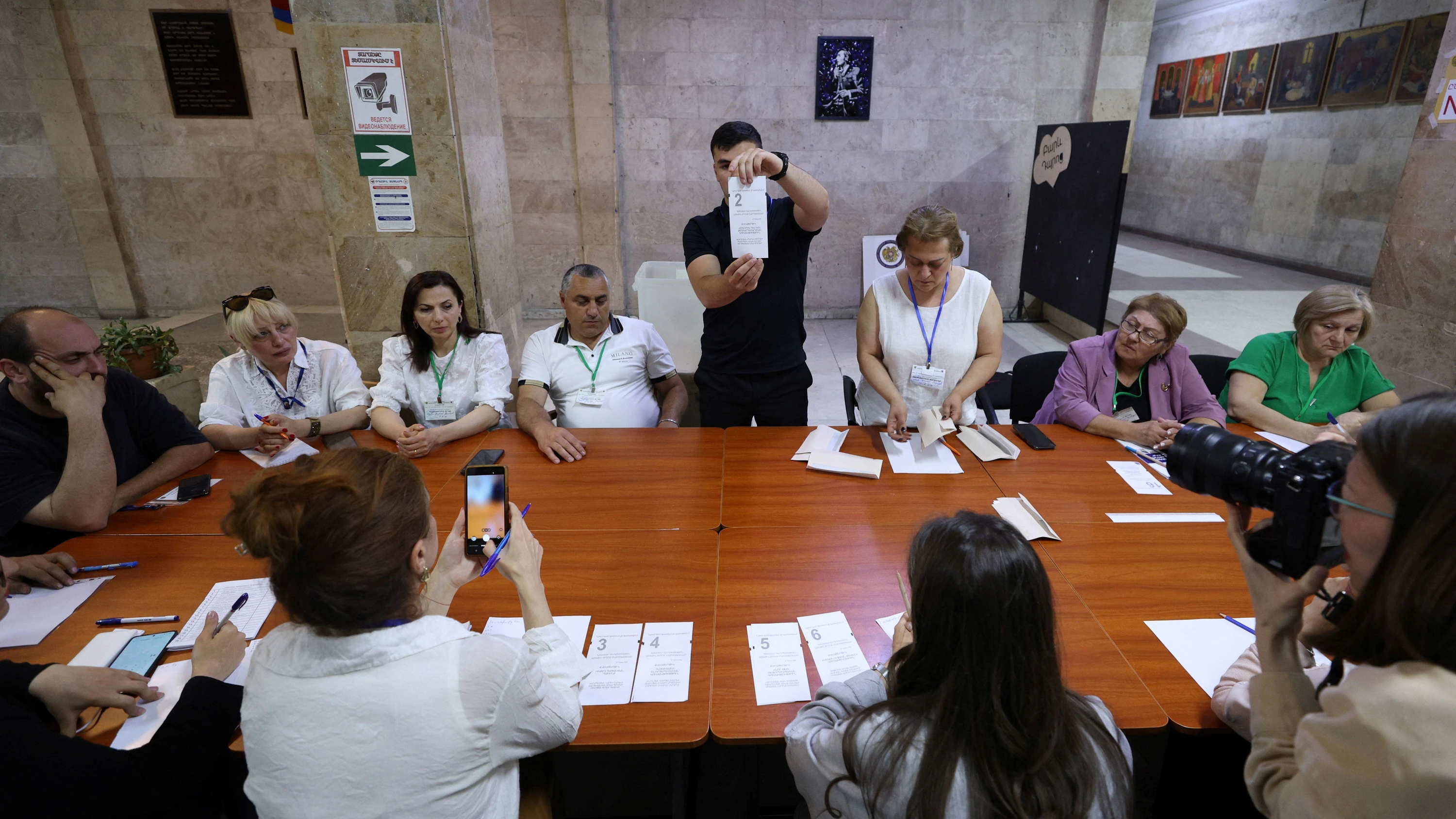
Armenia’s Prime Minister Nikol Pashinyan claimed victory on Monday after his pro-European Civil Contract party secured a commanding 54.5% of the vote in Sunday’s parliamentary elections, a result that accelerates the South Caucasus nation’s decisive pivot away from Moscow and toward the West. With nearly one-fifth of ballots counted by early Monday, the outcome underscores a historic shift in Armenian politics, defying Russian disinformation campaigns and Moscow’s warnings of punitive measures.
Pashinyan’s victory, confirmed by preliminary results, grants his party a majority sufficient to form the next government alone, ending months of speculation over Armenia’s geopolitical trajectory. The vote, held under intense scrutiny, saw turnout exceed 50%, reflecting broad public engagement despite Russia’s attempts to sway opinion through coordinated disinformation networks . Analysts noted that the campaign was marred by Kremlin-backed narratives amplifying divisions, yet voters ultimately rejected Moscow’s pressure in favor of closer ties with the European Union.
Russia’s Foreign Ministry swiftly responded, alleging “unprecedented pressure on the opposition” and “Western interference” in the election process . The Kremlin has already signaled economic retaliation, with Moscow threatening additional sanctions on Armenian goods, including fisheries, under the pretext of sanitary concerns . Yet analysts argue that such measures may prove counterproductive, further isolating Russia in a region where its influence continues to wane.
The election results also highlight a geographic divide in voter preferences. While Civil Contract performed strongly nationwide, its support was notably weaker in Yerevan compared to rural areas, where pro-Western sentiment remains robust . Political observers suggest this reflects broader societal divisions over Armenia’s post-war identity, particularly following the 2023 defeat in Nagorno-Karabakh, which Pashinyan’s government has framed as a necessary step toward peace and EU integration.
European leaders have hailed the vote as a mandate for reform. French President Emmanuel Macron and EU High Representative Josep Borrell issued statements welcoming Armenia’s democratic process and reaffirming Brussels’ commitment to deepening cooperation . Meanwhile, Pashinyan has reiterated his intention to pursue EU membership, signaling a new chapter in Armenia’s foreign policy.
As Yerevan prepares to form a government, the challenge ahead will be balancing its Western ambitions with the economic and security realities of its relationship with Russia. Yet for now, the message from Armenia’s voters is clear: the era of unquestioned allegiance to Moscow is over.
Follow us for live European news
- 3
- 2
- 1
- 1
- 1
- 1
- 1
1 further source not geolocated
Articles

Caucasian Knot | Political scientists have called the elections in Armenia a vote for the countrys course.
gdeltproject.org · 4 months ago
Jeyhun Bayramov: Today, there is stability in the South Caucasus with the participation of Azerbaijan, Türkiye and Georgia
gdeltproject.org · 4 months ago
Pashinyan party wins Armenia election amid west shift
gdeltproject.org · 4 months ago
Poised to accelerate a pivot away from Russia, Armenian prime minister claims election win
gdeltproject.org · 4 months ago
The incredible shrinking influence of Putins Russia Armenia is the latest country to leave Moscows orbit
financial times · 4 months ago
Russian interference in Armenia: A nation tested by disinformation Under the leadership of Prime Minister Nikol Pashinyan, Armenia is moving to distance itself from Russia and forge closer ties with the European Union. Despite pro-Russian disinformation campaigns targeting the government, the pro-European candidate won the parliamentary elections held on June 7.
france24 · 4 months ago
Turkish FM Fidan meets Georgian, Azerbaijani counterparts in Istanbul Foreign Minister Hakan Fidan held separate meetings with Georgian Foreign Minister Maka Botchorishvili and Azerbaijani Foreign Minister Jeyhun Bayramov in Istanbul, on the sidelines of a trilateral Türkiye-Azerbaijan-Georgia foreign ministers gathering. No details of the talks were disclosed.
yenisafak · 4 months ago
Russia claims Armenia election held under opposition pressure, Western interference Russias Foreign Ministry claimed that Armenias parliamentary election took place amid unprecedented pressure on the opposition and Western interference. Spokeswoman Maria Zakharova said preliminary results show declining support for the ruling Civil Contract party and a clear demand in Armenian society for closer ties with Russia.
yenisafak · 4 months ago
Wahl in Armenien: Der Westen muss auf dem Weg zum Frieden helfen Das Ergebnis der Wahl in Armenien ist eine Aufforderung an die EU und die USA, sich für einen dauerhaften Frieden im Kaukasus einzusetzen.
faz · 4 months ago
Arménie: après la victoire de Nikol Pachinian, quelle marge de manœuvre face à Moscou? La victoire du Premier ministre sortant Nikol Pachinian aux législatives du 7 juin confirme le virage de lArménie vers une diversification de sa politique étrangère, au plus grand dam de son allié historique russe. Mais Moscou conserve dimportants leviers de pression économiques et sécuritaires, prévient Tigrane Yégavian, spécialiste de lArménie et directeur de recherche pour la revue Conflits.
rfi.fr · 4 months ago
22 May 2026 - Armenia Election Monitor - The upcoming Armenian election will decide the future direction of the country
commonspace · 4 months ago
27 May 2026 - Armenia Election Monitor - Armenia at a crossroads: Elections, peace, and the limits of international guarantees
commonspace · 4 months ago
29 May 2026 - Armenia Election Monitor - Upcoming elections in Armenia: why is it important? - a view from Azerbaijan
commonspace · 4 months ago
3 June 2026 - Armenia Election Monitor - A strategic choice: Armenian voters between diversification and dependency
commonspace · 4 months ago
5 June 2026 - Armenia Election Monitor - Armenia goes to the polls, searching for a way forward
commonspace · 4 months ago
National Parliament Election in Armenia 🇦🇲 Unlike in many other capitals, the main party favouring EU integration (here: Civil Contract) performed more weakly in Yerevan than in rural communities. #ArmVote2026 Explore:
telegram bot · 4 months ago
FM Sybiha on Armenian election results: Russias influence continues to fade Attempts by Russia to influence election in Armenia have failed, just as they previously did in Romania, Moldova, Hungary, and other countries, demonstrating a weakening of Moscows geopolitical influence.
ukrinform · 4 months ago
Măsurile anunțate de Moscova, după ce premierul proeuropean al Armeniei a câștigat alegerile parlamentare Autoritățile ruse au avertizat Erevanul cu privire la introducerea unor restricții suplimentare asupra importurilor de produse pescărești armene. După cum a declarat luni șeful Agenției Federale pentru Pescuit, Ilya Shestakov, „vor urma cu siguranță măsuri suplimentare în cazul identificării unor riscuri în care astfel de produse „vor afecta siguranța noastră sanitar-veterinară.
digi24 · 4 months ago
„Cea mai mare problemă este lipsa unei opoziții democratice. Cum a reușit Nikol Pașinian să rămână la putere în Armenia Pentru majoritatea candidaților, o campanie electorală bazată pe pierderea patriei strămoșești și promovarea reconcilierii cu un inamic de lungă durată ar echivala cu o sinucidere politică. Nu și în Armenia. Duminică, prim-ministrul Nikol Pașinian și-a asigurat realegerea în această țară din Caucaz cu o populație de 3 milioane de locuitori, în ciuda faptului că, în urmă cu doar trei ani, a condus Armenia într-o înfrângere militară devastatoare în fața Azerbaidjanului, notează The Guardian.
digi24 · 4 months ago

Malgré les pressions de Moscou, Nikol Pachinian remporte les législatives en Arménie Après sa victoire aux élections législatives du 7 juin, le parti du Premier ministre, Nikol Pachinian, va pouvoir composer seul le prochain gouvernement arménien. La campagne électorale avait été marquée par un soutien prononcé des Européens en faveur de Pachinian, qui a répété son souhait de rapprocher son pays de lUE. Hostile à ce nouvel agenda politique, la Russie a fait planer la menace de lourdes conséquences et adopté contre Erevan des mesures économiques punitives. Elle promet de nouvelles sanctions.
courrier international · 4 months ago