
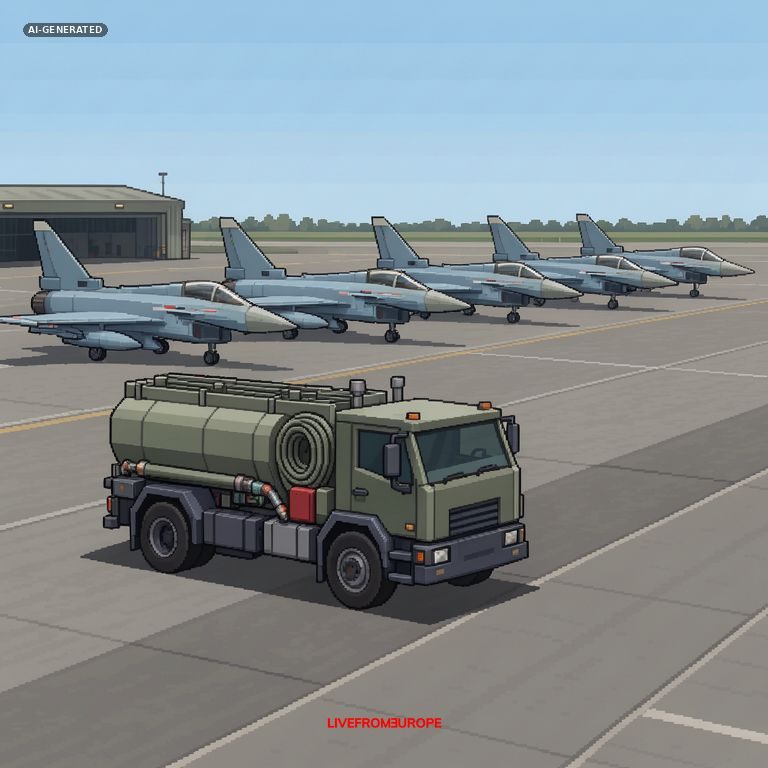
A study backed by NATO, the 32-member military alliance, warns that European fighter jets could run out of fuel in a future war as Europe's shift away from fossil fuels shrinks refining capacity.
The study, released in September by the NATO Energy Security Centre of Excellence, examined a scenario of full-scale conflict in NATO Europe triggered by Article 5, the alliance's collective defense clause. In that scenario, involving a major deployment of forces from North America, the fuel demands of NATO aircraft could outstrip available supplies within the coming decade.
Russian hybrid warfare and sabotage campaigns in recent months have caused renewed anxieties of a direct conflict with Moscow. European countries may lack sufficient fuel reserves to sustain a prolonged military conflict with Russia. Multibillion-euro defense budgets across the bloc are being spent on aircraft, tanks and missiles, but researchers say fuel constraints could hamper any future resistance.
Researchers partly attributed the shortages to decarbonization policies that have accelerated the closure of oil refineries. This has left NATO Europe facing shortages in diesel and aviation fuel, according to the researchers. Approximately one quarter of Europe's oil refineries have shut down since 2009, leaving roughly 70 operational refineries capable of supplying domestic aviation fuel needs. EU refining capacity has declined by 10 percent over the past 20 years.
"From a military readiness perspective, access to fuel is of paramount importance," a senior NATO military official said. "NATO needs reliable energy supplies to deter threats and defend itself. And sometimes those collective defense needs mean the military must take priority."
The report has circulated at a fairly high level within NATO and across the entire Alliance, a spokesperson for the NATO Energy Security Centre of Excellence said. "The urgent nature of this report and the simulation models it includes are undoubtedly due to the current geopolitical environment," the spokesperson said. How NATO can increase its refining capacity is "a good question" to which there is not yet an answer, a senior European security official said. The official added that this "is no reason to abandon the green transition."
In the plausible worst-case scenario, no level of restrictions on civilian consumption can balance the system from the mid-2030s onward without intervention, the researchers report. The study coincides with a Brussels-led initiative to strengthen EU refining capacity. European Commissioner for Energy Dan Jørgensen publicly warned last month that the decline has repercussions for defense.