Austria's government on Wednesday announced plans to widen the legal definition of espionage and double the maximum prison sentence to 10 years, seeking to shed Vienna's long-standing reputation as a den of spies.
Under current law, only spying against Austria is illegal, punishable by up to five years in prison. The new draft would extend criminal liability to spying against international organizations and the European Union, with sentences of up to five years for those offenses. Espionage against Austria itself would carry a maximum of 10 years. The bill also makes it a crime to recruit agents or agree to be recruited.
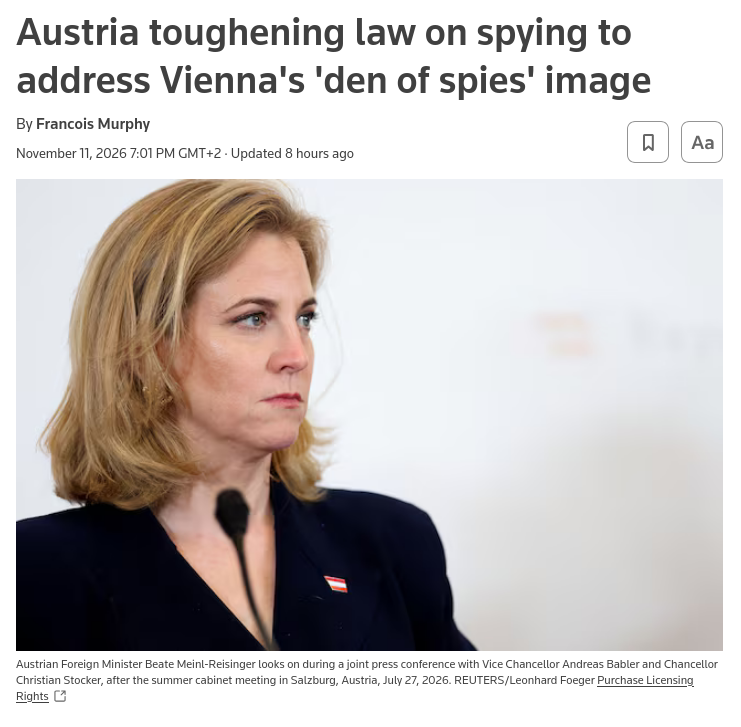
Vienna hosts the headquarters of the Organization for Security and Co-operation in Europe, the International Atomic Energy Agency and other United Nations bodies, a setting that has attracted intelligence agents operating under diplomatic immunity. Austria expelled four Russian diplomats in October for activities incompatible with their status, bringing the total to 18 since 2020. Austria is militarily neutral but has politically supported Ukraine since Russia's invasion in February 2022. Foreign Minister Beate Meinl-Reisinger said Vienna is often called the capital of espionage for historical reasons, referencing the romanticism of "The Third Man," adding: "I would like to clean up and end that."
Justice Minister Anna Sporrer sent the draft to parliamentary review on Wednesday. The current statute has been applied only rarely, with exceptions such as the case of Egisto Ott. The draft remains open for comment until December 20 and is scheduled for a vote in the Nationalrat next year.
The draft defines "detriment to Austria" to include threats to the country's reputation, prosperity or security, and would cover spying against other EU member states or foreign organizations conducted on Austrian soil. It also targets "throwaway agents" — young people recruited via social media for small sums to fly drones over military barracks or commit arson. Merely declaring a willingness to serve a foreign power would suffice for prosecution.
Interior Minister Gerhard Karner said espionage and spy attacks are rising and affect Austria's internal security, with some foreign intelligence services acting significantly more aggressively than before. The draft doubles penalties for cyber crimes linked to foreign services to protect critical infrastructure.
Prosecutors have warned that the justice system lacks the resources to handle the expanded caseload. Anna-Maria Wukovits, vice president of the Prosecutors' Association, said: "We are at the limit and have warned against enacting new criminal provisions." Anti-corruption expert Martin Kreutner warned in early November that prosecutors, investigators and courts would each need to increase capacity by a factor of 10 to avoid a dilemma.